
Is 25G SR Enough for AI Training Clusters
As AI workloads keep growing in scale, the network infrastructure beneath them has become make-or-break for training efficiency. Among all the connectivity options out there, 25G SR (Short Reach) optical modules are pretty common in data centers, they’re cost-effective and well-established.
The Networking Demands of AI Training Clusters
AI training clusters, particularly those used for deep learning, depend a lot on fast, smooth GPU-to-GPU communication. Distributed training frameworks like data parallelism and model parallelism need frequent syncs of gradients and parameters across nodes. This back-and-forth generates a ton of east-west traffic, which puts a lot of strain on network bandwidth, latency, and congestion control.
Modern GPUs can process data at incredible speeds, so the network has to keep pace, otherwise, it becomes a bottleneck. High throughput, ultra-low latency, and lossless transmission are non-negotiable, especially in large-scale clusters with hundreds or even thousands of GPUs.
Where 25G SR Fits In
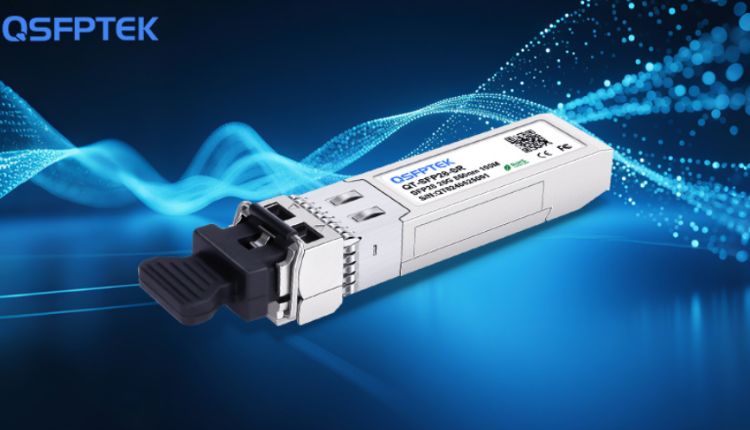
25G SR modules, usually based on the SFP28 form factor and running over multimode fiber (MMF), can transmit data up to 70–100 meters. They’re widely used for connecting Top-of-Rack (ToR) switches to servers, and they strike a nice balance between cost, power efficiency, and ease of deployment.
In AI setups, 25G SR still has its place, especially in smaller clusters or workloads that aren’t as sensitive to latency. For example, edge AI deployments, inference clusters, or training setups with only a few nodes might not need the extreme performance of faster interconnects. In those cases, 25G SR is a practical, budget-friendly solution.
Comparison with InfiniBand and 100G Ethernet
When you stack 25G SR up against high-performance interconnects like InfiniBand or 100G Ethernet, its limitations become much clearer.
InfiniBand, especially with technologies like RDMA (Remote Direct Memory Access), is built for ultra-low latency and high throughput. It lets GPUs access each other’s memory directly, without involving the CPU, which cuts down on communication overhead a lot. That’s why it’s the go-to choice for large-scale AI training clusters where sync speed is critical.
100G Ethernet, on the other hand, is often set up using 4×25G lanes. It offers a huge bandwidth upgrade over 25G while still working with existing Ethernet systems. It balances performance and flexibility, making it more and more popular in modern AI data centers.
25G SR, by contrast, doesn’t have enough bandwidth for the heavy GPU communication in large clusters. It also often needs more network hops and aggregation layers, which adds even more latency.
Suitable and Unsuitable Scenarios
25G SR works well for small to medium-sized AI training clusters, as well as edge AI deployments with limited infrastructure; it is also a practical choice for cost-sensitive environments where performance demands are moderate and inference workloads that don’t require heavy communication between nodes.
On the other hand, 25G SR is not a great fit for large-scale distributed training with hundreds of GPUs, high-performance computing (HPC) environments, workloads that need real-time sync and minimal latency, or next-gen AI models with massive parameter sizes, as it lacks the necessary bandwidth and speed for these demanding use cases.
Conclusion
While 25G SR remains a cost-effective choice for many data center applications, it is increasingly limited for AI training clusters due to growing GPU workload demands. It works for smaller setups, but larger, cutting-edge AI training requires faster interconnects like InfiniBand or 100G Ethernet. Ultimately, the right network depends on balancing performance, scalability, and budget.